Velvet for the Self-Made: The New American Ateliers Painting Instant Dynasties
The first thing one notices in the finished portrait is not the face. It is the velvet. Deep, light-drinking velvet, cut into a mantle that falls from the sitter’s shoulders with the confidence of an old regime. Then the sash, perhaps a muted crimson, and the hound—usually borrowed, occasionally the family pet, almost always positioned with the gravity of a heraldic beast. Only after these accoutrements does the viewer arrive at the subject: a technology founder from Austin, a hotelier from Charleston, a family matriarch from Lake Forest who wants her grandchildren to inherit a wall with a story on it.
Formal court portraiture, an art of monarchy and inherited privilege, is quietly finding a new market in the United States. The buyers are not aristocrats. They are self-made collectors, institution builders, and families who have accumulated enough wealth to want a visual record of it—but not so much history that a painted lineage already exists. Into that gap have stepped American ateliers willing to supply the grandeur without the genealogy.
The Velvet Economy
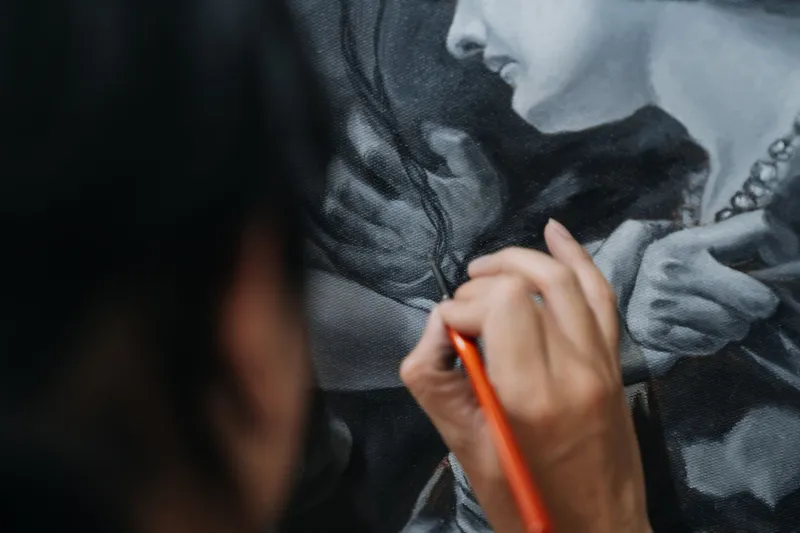
The revival is easiest to see in the studio, where the apparatus of old-master painting meets the logistics of contemporary American life. Sittings are scheduled around board meetings. Proposals arrive as PDFs. Fabric swatches are shipped overnight. The hound may be a rented show dog with an handler on standby, or a rescue mutt who will not sit still for the drapery study.
At Halcyon & Reed, a Hudson Valley atelier that occupies a former carriage house, the process begins with a questionnaire that reads like a cross between a family history and a brand audit. What objects matter? What rooms will the painting live in? Is the goal to suggest continuity, or to announce arrival? The studio’s principal painter, trained in Florence and formerly a conservator, works in a manner that borrows from seventeenth-century English portraiture without pretending to be it. Prices begin near $18,000 for a half-length canvas and climb past $75,000 for a full-length composition with architectural background and animal.
In Charleston, The Cuthbert Studio has found a brisk trade among hoteliers and hospitality families who want portraits for lobbies and private dining rooms. Its house style is warmer, more American Gilded Age than European court: less swordsmanship, more summer light. A full-length portrait with a veranda setting and a pair of dogs might run $45,000 to $90,000, depending on scale and the number of preparatory studies. The studio also offers a less expensive option—a head-and-shoulders oil for the study—that begins around $9,500. It is, in effect, a starter portrait for a dynasty still under construction.
Mesa Crown Atelier in Santa Fe takes a different route. Its painters work with a palette inspired by Spanish colonial and Mexican portraiture, and its clients often want something that feels regional rather than European. The studio has painted ranchers, art dealers, and a founder of a private aviation company. A three-quarter-length portrait with hand-worked gilt frame and custom crest consultation starts at $22,000. The crest, the studio is careful to note, is decorative rather than genealogical. It is a mark of identity, not a claim of descent.
Provenance Without Pedigree
For American buyers, provenance has become a delicate subject. Old-master portraits of actual aristocrats carry centuries of documentation, but they also carry a certain awkwardness: the buyer is a custodian, not the subject. A newly commissioned court portrait reverses that relationship. The sitter is central. The lineage begins now.
That reversal is the source of both the appeal and the unease. A painted portrait can make a founder look like a founder of something older than a company. It can give a family a visual anchor without requiring them to invent an ancestor. But it can also look like costume. The difference between a convincing portrait and a theatrical one usually comes down to restraint: the quality of the drawing, the intelligence of the setting, the willingness to let the face carry authority rather than the sash.
The better studios speak of “psychological likeness” rather than flattery. They ask clients to sit for multiple studies. They resist the urge to add too many symbols. One painter at Halcyon & Reed tells clients that a hound should be included only if the hound belongs to the sitter’s life, not merely to the fantasy. “A borrowed dog is still a borrowed dog,” she says. “The painting knows.”
The Dynasty Wall
Real estate has driven part of the demand. Americans are building houses with long galleries and stair halls designed for ancestral portraits, even when the ancestry is thin. A formal portrait solves a decorative problem—how to make a new house feel inhabited—and a psychological one. It says: someone was here before you, even if that someone is you, ten years ago, before the first acquisition.
Museums and auction houses have noticed. Portrait commissions are not typically sold at auction, but the secondary market for contemporary formal portraiture is developing, and some advisers now recommend commissioning a portrait as part of an estate plan. The painting becomes a document, a family object, and a conspicuous piece of craftsmanship in an era when handmade things are increasingly rare. In that sense, the new court portrait belongs as much to the category of heirloom furniture or bespoke jewelry as to fine art.
Whether the trend will produce a durable American school of court portraiture is another matter. The market is small, the training pipeline is fragile, and the line between homage and pastiche is easy to cross. Yet the appetite is real. In a country that has always preferred to invent itself, the painted court portrait offers a paradoxical pleasure: the look of inherited authority, commissioned from scratch.
For now, the hounds are still borrowed, the sashes are newly sewn, and the velvet is very good. The dynasty, such as it is, begins on the wall.