The Quiet Vaults: Where America's Next Heirlooms Are Forged Behind Locked Doors
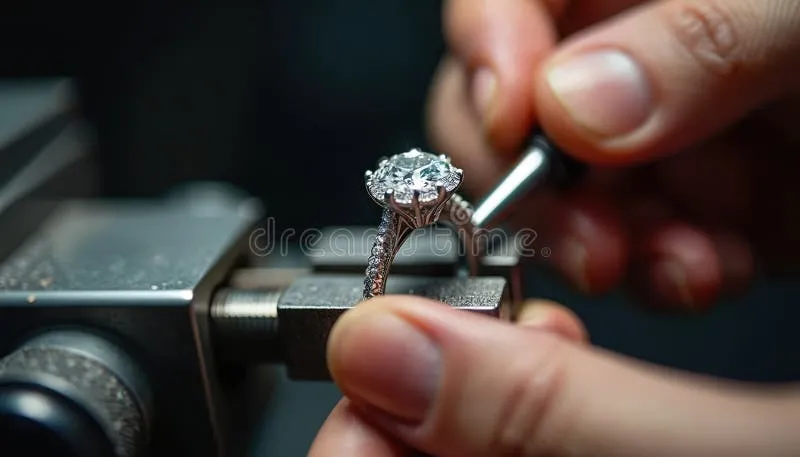
Photo: master jeweler working on diamond ring in luxury atelier workshop, via thumbs.dreamstime.com
There is no signage. No storefront. In certain discreet buildings along Fifth Avenue and, increasingly, in the hills above Los Angeles, the most consequential jewelry in America is being made in rooms most people will never enter. Access is granted by referral alone. Contracts are signed under nondisclosure. And the pieces produced within — rings, rivieres, parures destined to be worn once and then locked away for a century — represent what many in the trade now consider the most rational luxury purchase a wealthy American family can make.
Welcome to the heirloom atelier, where patience is measured in years and the client list reads like a private equity directory.
A Commission Measured in Years, Not Weeks
The process begins, paradoxically, with conversation rather than carats. Master jewelers describe initial consultations that stretch across multiple meetings — sometimes involving three generations of a family seated around a single table — before a single sketch is committed to paper. Stones are sourced through a global network of dealers in Antwerp, Geneva, and Jaipur. A rare Colombian emerald or an old-mine-cut diamond with provenance can take eighteen months to locate.
Then comes the making. A single necklace may consume two thousand hours of a gemologist's and setter's combined attention. One New York-based craftsman, who asked to remain anonymous per his clients' preferences, describes the work as "architecture in miniature — except the building has to survive two hundred years of ballrooms, safes, and inheritance disputes."
Commissions routinely cross the seven-figure threshold. The record-setting pieces — those that surface, decades later, at Sotheby's or Christie's — frequently began as private gifts within families whose names never appeared in the paperwork.
The Psychology of Permanence
Why do accomplished, financially sophisticated people sink fortunes into objects they may wear only a handful of times? The answer, according to wealth advisors and family-office consultants, has less to do with vanity than with continuity.
"Heirloom jewelry is one of the few assets that carries story as well as value," says one Manhattan-based advisor to families of significant means. "A portfolio can't be handed to a granddaughter on her wedding day with any emotional weight. A brooch commissioned to mark a matriarch's sixtieth year can."
There is also a quietly pragmatic logic at work. Fine gemstones — particularly rare colored stones of top provenance — have appreciated substantially over the past two decades, outpacing many traditional asset classes during periods of market turbulence. Unlike real estate, jewels are portable. Unlike art, they require no climate-controlled warehouse. A family's entire mobile wealth can, in principle, be sewn into the lining of a single evening gown.
The psychology extends to legacy planning. Estate attorneys report that well-structured jewelry bequests — with documented provenance, insurance schedules, and clear succession instructions — generate markedly fewer family conflicts than less tangible inheritances. The stone becomes a treaty.
The Bespoke Boom
The American market for one-of-a-kind commissions has swelled noticeably in the past decade. Industry observers point to a confluence of forces: a new generation of tech and private-equity wealth seeking differentiation from mass luxury; growing skepticism of logo-driven consumption; and a broader cultural turn toward the singular and the enduring.
Auction results have reinforced the thesis. When named collections — the estates of American heiresses, Hollywood legends, and industrial dynasties — come to market, they routinely shatter estimates. Each headline result sends another wave of collectors back to their jewelers with a simple request: make something worth that kind of attention in a hundred years.
The ateliers themselves remain stubbornly small. The finest American houses cap their annual commissions deliberately, and waiting lists of two to four years are common. Scarcity, in this corner of the market, is not a marketing strategy. It is a structural reality of craftsmanship that cannot be scaled.
What Aspiring Collectors Should Know
For those entering this world, experts offer consistent counsel. Buy the stone before the design. Insist on full gemological certification from recognized laboratories. Document everything — photographs, provenance papers, insurance appraisals — and revisit valuations every three years. Most importantly, commission with a story in mind: the finest heirlooms are designed around a narrative, an anniversary, a promise, an origin, because the story is what the next generation actually inherits.
The vaults will remain locked, the client lists sealed. But somewhere in America right now, a jeweler is setting a stone that will be fought over, treasured, and passed down long after everyone involved is gone. That, more than any certificate of authenticity, is the true product.