The Marble Afterword: How American Families Commission Eternity
The American funeral is frequently described as an exercise in brevity. Cremation now accounts for a majority of dispositions in the United States, services are shorter, and the family plot—once a fixed coordinate on the national landscape—has loosened its hold on the national imagination. Yet at the quieter end of the market, a countervailing trade has taken root. In stone yards from Barre, Vermont, to the hills outside Asheville, North Carolina, and in bronze foundries outside Philadelphia, a small network of ateliers is building private mausoleums, heraldic urns, and funeral regalia for families who intend to be remembered in architecture rather than in memory alone.
A Commission That Begins With a Blank Plot
The work rarely starts with a drawing. It starts with a deed. A family acquires a plot in a private cemetery, a churchyard, or—increasingly—a parcel of land held in a family trust, and then approaches an architect or a monument atelier with a request that is at once simple and impossible: build something that will still stand when the family name has outlived its current generation. The atelier surveys soil conditions and the frost line, studies local cemetery regulations and state law on private burial structures, and confronts the practical questions that separate a monument from a building. A mausoleum requires a foundation, ventilation, drainage, and a door that will open and close for a century. “We are not selling a headstone,” one Vermont stone carver said. “We are selling a small building with a very long lease.”
Stone, Bronze, and the Language of Permanence
The materials are traditional because tradition is the point. Granite remains the dominant stone—durable, available from a range of American quarries, and amenable to both rough-hewn massing and fine lettering. Marble appears in interiors and in the carved panels that families commission for the entrance. Bronze is reserved for doors, urns, and the kind of low-relief portrait plaques that once decorated bank lobbies and now decorate crypt fronts. Stained glass has returned in a modest way, often in a single oculus or a narrow lancet that throws colored light across a marble bench. The iconography is carefully calibrated. Families arrive with coats of arms, monograms, and Latin inscriptions; ateliers push back gently. The best work, the craftsmen argue, is legible at fifty feet and silent at five.
The Crypt as a Family Room
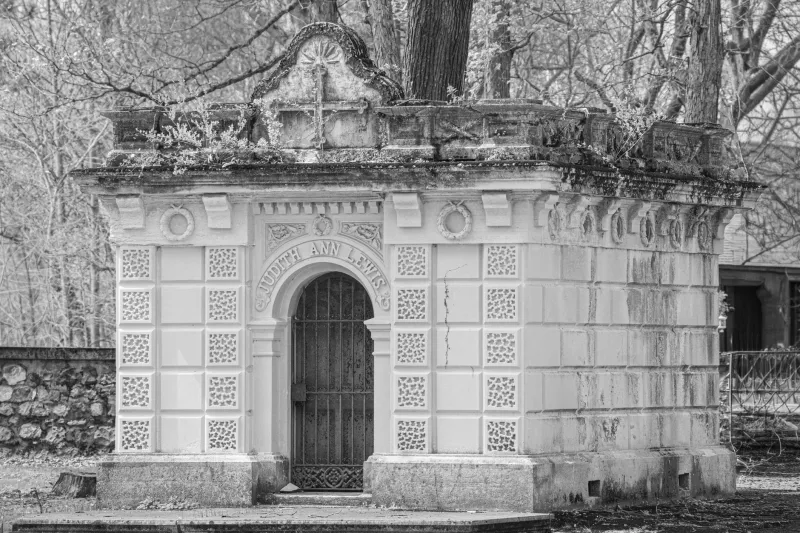
The interior of the contemporary American mausoleum is a study in domestic scale. Where earlier generations built dim chambers lined with stacked sarcophagi, today’s commissions often include a visitation room with seating, a niche wall for urns, and lighting designed to be adjusted for private ceremonies. Some families install climate control; others insist on natural ventilation and a stone bench positioned to catch the morning light. The effect is less crypt than family room with a longer horizon. This is the staging of dynastic continuity in its most literal form: a room where the living and the dead are understood to share an address.
Discretion and Its Limits
The families who commission these structures generally prize discretion. Non-disclosure agreements are common; ateliers decline to name clients; cemeteries in rural states are chosen in part because they are not on the tourist route. But a mausoleum is, by its nature, a public object. It sits on land that can be seen from a road, appears in local historical surveys, and occasionally draws the attention of a landmarks commission. The tension is managed rather than resolved. Some families plant hedges; others commission gatehouses that read as garden follies. “You cannot build a private palace in a public landscape and expect no one to notice,” one architect observed. “You can only decide what they will notice.”
The Green Counterpoint
The rise of natural burial and conservation cemeteries has not gone unnoticed in the ateliers. Some now offer what they call “integrated landscapes”—native plantings, unpaved paths, and structures designed to weather into the ground rather than stand against it. The gesture is partly ecological and partly strategic: a family that might recoil at a marble pavilion may accept a low granite wall set into a meadow. The underlying premise, however, remains unchanged. The commission is still an argument about time, and the ateliers are still in the business of making that argument in stone.
What the Stone Cannot Hold
A mausoleum is a curious kind of legacy. It preserves a name, a date, and a set of architectural decisions, but it cannot preserve the reasons behind them. The family that commissions a chapel in granite is making a bet that the descendants who inherit it will understand the bet. Sometimes they do. Often the building becomes a landmark before it becomes an heirloom—visited by genealogists, photographed by passersby, absorbed into the local landscape as a curiosity rather than a shrine. The ateliers know this, and they build accordingly: for the family, yes, but also for the stranger who will one day stand at the gate and wonder who thought it was worth the trouble.