The Deliberate Crumble: Why America’s Estates Are Building Ruins on Purpose
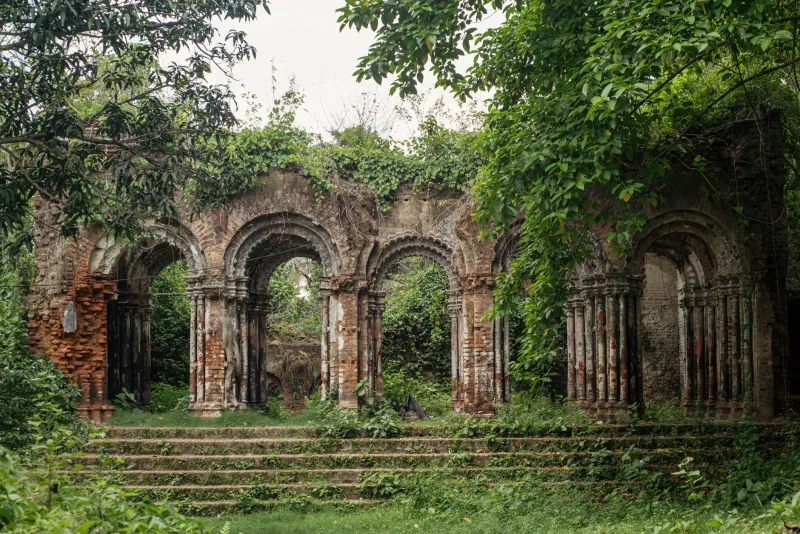
The first thing visitors notice at a certain 112-acre estate in Dutchess County is not the house. It is the temple. A limestone portico, open to the sky, stands at the end of a allee of lindens; three columns remain upright, a fourth leans at a angle that looks accidental but was calculated to the degree. Moss creeps along the architrave. A shallow basin, fed by a hidden pump, catches water in the old manner. The structure is eighteen months old.
Such commissions were once the eccentric province of a few aristocratic hobbyists. Landscape architects and specialty masonry firms now describe artificial ruins as a recognizable category of American luxury, one that has moved from the fringes of the estate world into its central repertoire. The clients are not, for the most part, families with centuries of accumulated property. They are entrepreneurs, financiers, and entertainment figures who have bought land in the past fifteen years and want to furnish it with a past they did not inherit.
The Romance of the Broken Column
The folly has a long and respectable pedigree. In eighteenth-century England, the landscape garden at Stowe and the watery grottoes of Stourhead used sham ruins to compress history into a view: a temple here, a Gothic fragment there, a hermitage for atmosphere. American Gilded Age owners imported the fashion along with European stone and European architects. What is new is the scale and the craft. Today’s ruins are not plywood stage sets. They are engineered masonry, built to weather, drain, and hold their shape for a century—or at least to appear as though they already have.
“The paradox is the point,” said one landscape architect based in the Hudson Valley, who asked not to be named because her clients prefer discretion. “You are building something new that must read as old. Every decision—the joint widths, the way the stone is pitched, the lichen—is an argument about time.”
What It Costs to Look Forgotten
The trade runs from modest to monumental. A grotto tucked into a hillside, lined with rough stone and fitted with a bench and a concealed light source, might begin around $150,000. A free-standing temple with salvaged columns, custom cornice, and integrated drainage can exceed $2 million before planting. Designers source fragments from European salvage dealers and domestic quarries; some firms cast new stone and then distress it by hand, using acid washes, wire brushes, and a slurry of buttermilk and moss spores that encourages lichen to take hold. The most convincing ruins are not ruined at all but stabilized—steel armatures hidden inside crumbled masonry, footings designed for frost heave, weep holes disguised as cracks.
“The client wants decay, but not failure,” said a principal at a Pennsylvania firm that specializes in historic masonry. “We spend a great deal of time explaining that a real ruin is a hazard, and a commissioned ruin is an amenity.”
The Permitting Paradox
Zoning is where the fantasy meets the building department. In many American towns, an unoccupiable garden structure falls outside the strictures of residential code, provided it is not wired for habitation and does not exceed height or setback limits. That classification can smooth the path for a folly but complicate it elsewhere: historic district commissions may object to new construction designed to look old, coastal review boards worry about runoff and bluff stability, and some municipalities have begun to ask whether a “ruin” intended for dinner parties is really a structure in disguise. Insurance carriers, meanwhile, want to know who is responsible when a guest trips on a loose flagstone that was deliberately laid loose.
In Napa and Sonoma, where the backdrop is already theatrical, a few estates have used ruins as landscape features around tasting pavilions. In Montecito and the hills above Santa Barbara, the preference runs to Roman fragments and grottoes in the Italian manner; in Virginia horse country, Gothic arches and faux chapels. The common thread is not a period but a mood—melancholy, permanence, a suggestion that the land has outlasted its owners.
A Backdrop for the Modern Court
The social function is unmistakable. A ruin creates a room without walls, a destination for a walk, a frame for a photograph, and a conversation piece that flatters the host’s taste without announcing his expenditure. Wedding planners have learned to place ceremonies beneath broken pediments; caterers use the shelter of a grotto for champagne service in light rain. The ruin is, in this sense, the opposite of the modernist pavilion: it does not assert the present but politely declines to compete with it.
There is also a subtler appeal. For owners whose fortunes are recent, a ruin offers a narrative of endurance without the burden of actual ancestors. It suggests that the family has already survived something—history itself—and that the estate is not merely a possession but a small country with its own antiquities.
The Psychology of Manufactured Time
Landscape historians are divided on whether this constitutes a genuine revival or a decorative indulgence. The eighteenth-century garden was an intellectual exercise, full of political and literary references; today’s commissions are more often driven by atmosphere and entertainment. Yet the impulses overlap. A ruin is an argument about scale: it makes the present feel temporary and the landscape feel older than any deed. It is also, for the owner, a form of control—an antiquity that can be commissioned, revised, and illuminated on a schedule.
Whether that control is admirable or absurd is a matter of taste. What is certain is that the trade is growing. The firms that build ruins report waiting lists. The quarries that supply distressed stone have learned to ask whether the order is for a garden or a film set. And on a growing number of American estates, the newest structure on the property is the one designed to look as though it has always been there—crumbling, mossed, and entirely on purpose.